

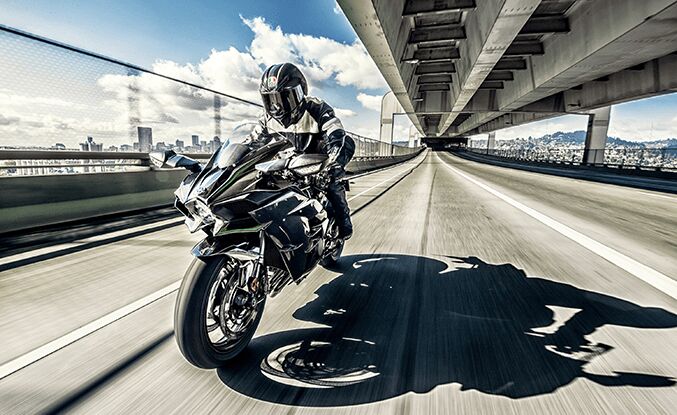
We’ve known for a while that Kawasaki is a Hybrid motorcycle, but a recently published patent suggests it can be combined with another Kawasaki technology called a compressor. More specifically, the patent describes an electrically powered compressor with a motor capable of driving both the motorcycle and the compressor impeller.
While the concepts in a patent are noteworthy in their own right, they don’t always manifest themselves in an actual product, but a Kawasaki trademark application filed earlier this year suggests that a hybrid motorcycle with an electric compressor may have already passed the concept stage. On March 29, Kawasaki registered the “E-BOOST” trademark in Japan for a range of applications, including hybrid and electric motorcycles. While we initially assumed that the “boost” was referring to an electrically assisted hybrid mode, we now believe that it could actually refer to the electric compressor.
Kawasaki’s has had compressor motorcycles in its range for several years, with the H2, H2R, H2 SX and Z H2, but all use a compressor that is chain-driven from the engine’s crankshaft. Instead of using a mechanical connection to the motor, an electric compressor uses an electric motor to turn the impeller. In theory, an electric compressor would work instantly, avoiding any delay in waiting for the engine to start up.
The downside is that an electric compressor requires more parts, with a motor and battery large enough to provide a charged boost when needed. For a gasoline powered motorcycle, that’s a lot of extra weight for a marginal gain. However, on a hybrid motorcycle, these parts are already present. If a hybrid is supposed to be heavier, says Kawasaki, he can give these additional parts a secondary use as well.
The patent describes the various modes a vehicle could use with a combination of a gas powered engine, an electric motor, and a compressor. The engine has an output shaft that is directly connected to the compressor. The output shaft is also connected to the input shaft of the transmission via an overrunning clutch. The clutch controls whether the engine can drive the input shaft, with the motorcycle operating in either electric or hybrid mode.
In hybrid electric mode, the internal combustion engine (E in the diagrams) and the motor (M) both drive the input shaft. In electric mode, an actuator (# 15) disconnects the main clutch and the motor stops so that the motor alone drives the input shaft. In both HEV and EV modes, inertial forces from deceleration switch the engine to regeneration mode. It is important to note that the electric motor is “upstream” of the transmission in both modes and, in contrast to most electric motorcycles, which work with a single gear, the motorcycle can still shift gear in electric mode.
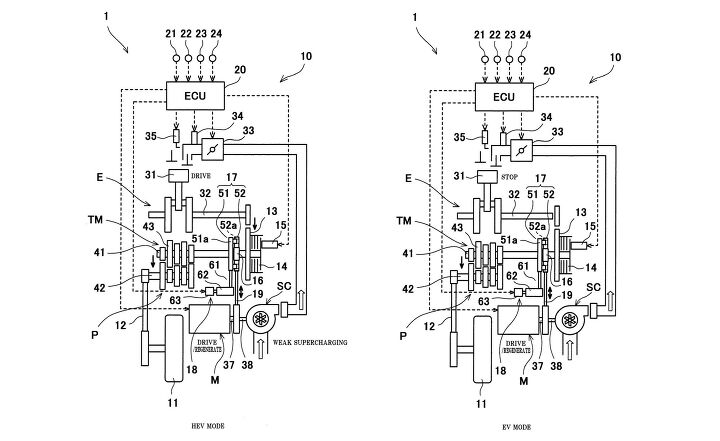
In “normal” mode, the combustion engine becomes the primary drive source, while the electric motor works in regeneration mode. In both normal and HEV modes, the engine spins at about 5500 RPM or slower, with the compressor operating at what the patent calls “weak boost” which gives the engine extra thrust. It continues in charging mode, with the clutch of the electric motor disconnecting from the input shaft in order to dedicate its full power (from 6000 to approx. 15,000 rpm) to driving the compressor.
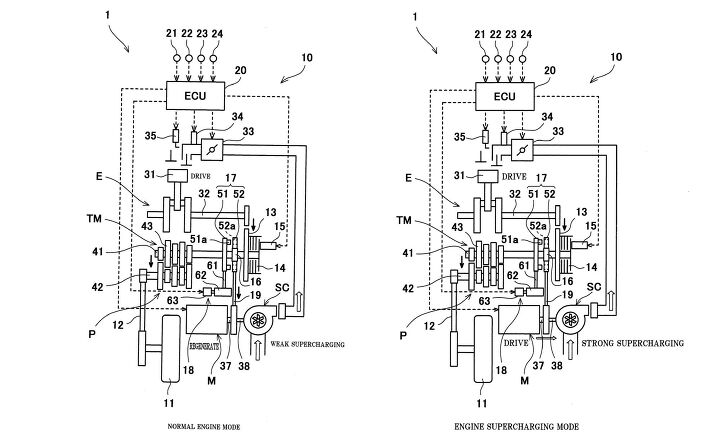
According to the patent, the motorcycle can switch between modes manually via driver input or automatically and select the mode based on various factors such as engine speed, vehicle speed, acceleration, gear selection and battery level.
Again, we have to repeat that filing a patent does not mean we will see a hybrid supercharged Kawasaki motorcycle anytime soon; it just tells us that Kawasaki was working on one. The trademark registration for “E-BOOST” indicates that the development of its hybrid project is so advanced that Kawasaki has decided to give it a name. It’s been a while since Kawasaki released an update on its hybrid motorcycle project, but recent comments from Kawasaki show that the company is committed to technology.
Earlier this week, Kawasaki announced a $ 265 million investment to expand its Nebraska facility and build a new facility in Mexico. In the announcement, Hiroshi Ito, President of Kawasaki Heavy Industry’s Motorcycle and Engine Company, said the company “is also increasing investment in new product development that will be available in the near future, particularly in the growing MULE, ATV markets and JetSki ”. as innovative new street motorcycles, our new electric, hybrid and hydrogen energy source projects and off-road motorcycles. “
We expect Ito to further develop these plans in October when Kawasaki’s motorcycle and engine business is officially spun off into its own company.
To become something Motorrad.com Insider. Get the latest motorcycle news first by subscribing to our newsletter here.

Comments are closed.